
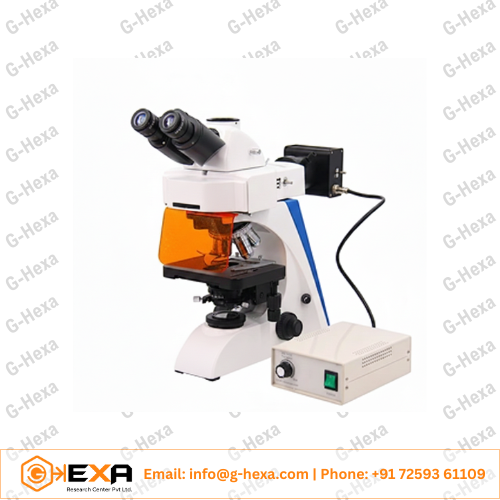
LED Fluorescent Microscope GHEXA-16.2601-L-T2
| Parameter | Value |
|---|---|
| Product Name | Trinocular LED Fluorescence Microscope |
| Model | GHEXA-16.2601-L-T2 |
| Head | Trinocular, 30° inclined, 360° rotatable, interpupillary distance 48–75 mm, light split 100:0 / 20:80 |
| Eyepieces | Wide Field WF10x/20 mm (pair, high eyepoint) |
| Nosepiece | Quadruple, reversed ball-bearing |
| Objectives | Infinity-corrected E-Plan Achromatic: 4x, 10x, 40x (spring), 100x (spring, oil immersion) |
| Stage | Double-layer mechanical stage 140×132 mm (approx.), coaxial X/Y controls, right-hand low position, specimen holder |
| Focusing | Coaxial coarse & fine focusing, fine division 0.002 mm, tension adjustable, upper limit stop |
| Condenser | Abbe N.A. 1.25 with iris diaphragm and filter holder |
| Transmitted Illumination | 3W high-brightness LED, adjustable intensity, long life (>50,000 hours) |
| Fluorescence Illumination | 5W disc-type LED fluorescence module, integrated B (Blue) and G (Green) excitation filter sets, dichroic mirrors & barrier filters |
| Fluorescence Filters | B (FITC/GFP ~450–490 nm exc.), G (TRITC/Cy3 ~510–550 nm exc.) – standard China sets |
| Power Supply | Safety low-voltage charger (input 100–240V AC), output DC for LED modules |
| Packaging | 1 pc per shipment (2 cartons), main carton approx. 42×28×45 cm, total gross/net weight 18/15 kg |
Payment. Payment upon receipt of goods, Payment by card in the department, Google Pay, Online card, -5% discount in case of payment
Warranty. The Consumer Protection Act does not provide for the return of this product of proper quality.
Description
GHEXA-16.2601-L-T2
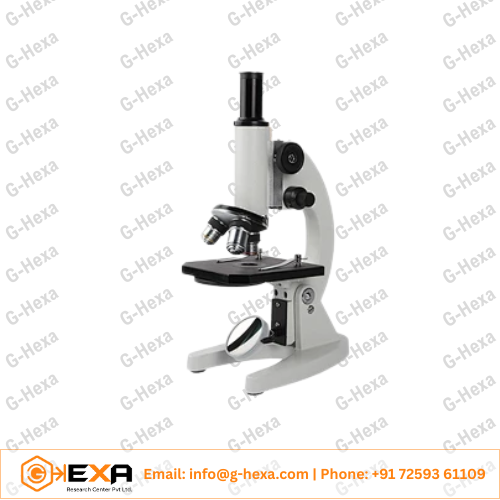
GHEXA-16.2601-L-T2 is a modern, safe, and cost-effective trinocular LED fluorescence microscope designed for routine and educational fluorescence applications in universities, diagnostic labs, biotech startups, and teaching hospitals. Equipped with infinity-corrected E-Plan objectives (4x, 10x, 40x, 100x oil), wide-field WF10x/20 mm eyepieces, a bright 3W LED transmitted illuminator with low-voltage safety charger, and an integrated 5W disc-type LED fluorescence unit with standard China B (Blue) and G (Green) filter sets, this model delivers reliable FITC/TRITC/Cy3-compatible fluorescence observation, brightfield performance, and comfortable trinocular imaging — all in a compact, energy-efficient package ideal for immunofluorescence, cell biology practicals, and basic clinical screening.
Specifications
| Parameter | Value |
|---|---|
| Product Name | Trinocular LED Fluorescence Microscope |
| Model | GHEXA-16.2601-L-T2 |
| Head | Trinocular, 30° inclined, 360° rotatable, interpupillary distance 48–75 mm, light split 100:0 / 20:80 |
| Eyepieces | Wide Field WF10x/20 mm (pair, high eyepoint) |
| Nosepiece | Quadruple, reversed ball-bearing |
| Objectives | Infinity-corrected E-Plan Achromatic: 4x, 10x, 40x (spring), 100x (spring, oil immersion) |
| Stage | Double-layer mechanical stage 140×132 mm (approx.), coaxial X/Y controls, right-hand low position, specimen holder |
| Focusing | Coaxial coarse & fine focusing, fine division 0.002 mm, tension adjustable, upper limit stop |
| Condenser | Abbe N.A. 1.25 with iris diaphragm and filter holder |
| Transmitted Illumination | 3W high-brightness LED, adjustable intensity, long life (>50,000 hours) |
| Fluorescence Illumination | 5W disc-type LED fluorescence module, integrated B (Blue) and G (Green) excitation filter sets, dichroic mirrors & barrier filters |
| Fluorescence Filters | B (FITC/GFP ~450–490 nm exc.), G (TRITC/Cy3 ~510–550 nm exc.) – standard China sets |
| Power Supply | Safety low-voltage charger (input 100–240V AC), output DC for LED modules |
| Packaging | 1 pc per shipment (2 cartons), main carton approx. 42×28×45 cm, total gross/net weight 18/15 kg |
Key Applications & Uses
- Routine immunofluorescence (IF) staining for detection of antigens, antibodies, cytoskeletal proteins, and cellular markers in fixed cell cultures and tissue sections.
- Basic fluorescence microscopy in university teaching labs — practicals on cell biology, microbiology, immunology, and histology using common fluorophores (FITC, TRITC, DAPI-compatible with upgrades).
- Clinical and diagnostic screening in pathology, microbiology, and parasitology labs — observation of fluorescently labeled bacteria, parasites (e.g., malaria, TB smears), viral antigens, and autoimmune markers.
- Biotech and pharma R&D entry-level applications — cell viability assays, apoptosis detection, reporter gene expression (GFP), and simple multi-color labeling studies.
- Brightfield + fluorescence combination — seamless switching for correlated morphological and fluorescent analysis of the same specimen.
- Digital imaging — trinocular port allows attachment of affordable microscope cameras for documentation, student reports, and basic publication images.
Why Choose from G-Hexa?
- Safe & energy-efficient LED technology — Both transmitted (3W) and fluorescence (5W disc LED) use long-life LEDs with low heat output, no warm-up time, and a safety low-voltage charger — safer for students and more economical than traditional mercury lamps.
- Integrated B & G fluorescence — Ready-to-use Blue and Green channels cover the most common fluorophores (FITC, GFP, TRITC, Cy3) without additional filter cube purchases for routine work.
- Infinity E-Plan optics — Delivers flat, high-contrast images across the field with improved chromatic correction over standard achromats — excellent for both brightfield and fluorescence.
- Trinocular convenience — Dedicated phototube for simultaneous eyepiece viewing and camera attachment, ideal for teaching, collaboration, and digital documentation in busy labs.
- Compact & portable design — Lightweight (15 kg net), two-carton packaging for easy handling and shipping, perfect for educational institutions, small biotech labs, and mobile training setups.
- G-Hexa value & reliability — Affordable pricing for entry-level fluorescence, backed by expert support, 1-year warranty, fast delivery from Pune stock, and upgrade paths (UV/DAPI, LED upgrade kits) as your needs grow.
Frequently Asked Questions (FAQs)
Q: Which fluorophores are supported by the standard B and G filters on GHEXA-16.2601-L-T2? A: The B (Blue) channel is optimized for FITC, Alexa Fluor 488, and GFP; the G (Green) channel supports TRITC, Cy3, Rhodamine, and similar red-shifted dyes. UV/DAPI requires an optional additional filter set.
Q: Is the fluorescence LED brighter or more stable than mercury lamps? A: The 5W disc LED provides instant-on, stable intensity with no warm-up, no bulb alignment, and significantly longer life (>10,000–30,000 hours) compared to mercury lamps, though peak UV intensity may be lower (UV channel optional).
Q: Can I use this microscope for live-cell fluorescence imaging? A: Yes — the cool LED illumination minimizes phototoxicity and heat damage, making it suitable for short- to medium-term live-cell fluorescence observation (add environmental control for long-term studies).
Q: How do I attach a camera? A: The trinocular head includes a C-mount phototube (typically 23.2 mm or 30 mm port). Use a 0.5x or 1x C-mount adapter depending on your camera sensor size — contact G-Hexa for compatible camera recommendations.
Q: Is the microscope suitable only for fluorescence, or does it perform well in brightfield? A: Excellent brightfield performance with infinity E-Plan objectives, 3W LED transmitted light, and Abbe condenser — ideal for routine staining, blood smears, and general histology alongside fluorescence.
Q: What maintenance is required for the LED fluorescence unit? A: Virtually maintenance-free — LEDs have extremely long service life and do not require alignment or replacement like mercury bulbs. Simply adjust intensity as needed; no cooling fans or hazardous waste concerns.


Reviews
There are no reviews yet.