
Your Cart
Add $300.00 to cart and get free shipping!
No products in the cart.
Free Shipping on All Orders Over $750
Add $300.00 to cart and get free shipping!
No products in the cart.
Free Shipping on All Orders Over $750
Surface & Thermal Stability Analysis
Thermal Analysis (TGA / DSC)
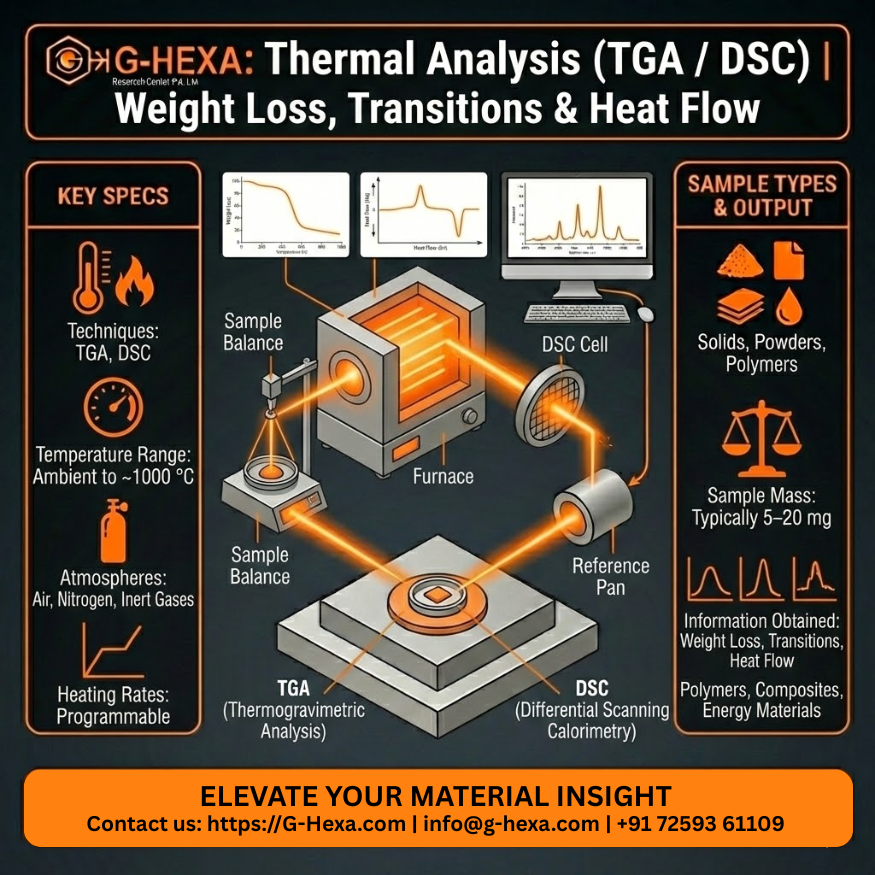
Bridging Thermal Behavior with Real-World Performance
Temperature is not just a variable — it is a stress test of material integrity. Whether evaluating polymer stability, oxidation resistance of alloys, curing behavior of composites, or decomposition kinetics, thermal analysis exposes transitions that determine product reliability.
At G-Hexa, TGA and DSC are not standalone measurements. They are integrated diagnostic tools that reveal:
Stability limits
Phase transformations
Glass transition behavior
Reaction mechanisms
Moisture and volatile content
By correlating thermal data with process conditions, we bridge laboratory thermograms with manufacturing reality.
ADVANCED THERMAL ANALYSIS CAPABILITIES
Temperature Range
Mass Resolution (TGA)
Heat Flow Sensitivity (DSC)
Controlled Atmospheres
Expert Sample Preparation Workflow
- Sample mass optimization (typically 5–20 mg depending on material type)
- Pan selection (open, sealed, alumina, platinum)
- Controlled atmosphere programming
- Baseline calibration and temperature correction
- Heating rate optimization for resolution vs. kinetics
- Repeat validation for data reliability
Challenges in Thermal Analysis
Thermal transitions can overlap, especially in polymer blends, composites, or filled systems. Moisture presence, volatile components, and heating rate variations may distort results.
Our expertise ensures:
Accurate differentiation between decomposition and evaporation
Reliable Tg detection in complex matrices
Correct oxidation onset interpretation
Reproducible kinetic modeling
Thermograms are interpreted not as curves — but as mechanistic signatures.
| Material Domain | Thermal Insight | Optimization Impact |
|---|---|---|
| Polymers | Glass transition & melting behavior | Processing temperature window optimization |
| Composites | Cure kinetics & residual reactions | Improved curing cycles & structural integrity |
| Metals & Alloys | Oxidation onset & stability limits | High-temperature performance validation |
| Pharmaceuticals | Decomposition profile & polymorphism | Shelf-life prediction & formulation stability |
| Battery Materials | Thermal runaway thresholds | Safety enhancement & material redesign |
High-Stakes Insight
Early Decomposition Detection
Cure & Reaction Kinetics
Glass Transition & Melting Studies
Oxidation & Stability Testing
From Failure Analysis to Future Material Systems
Thermal analysis supports both diagnostic and developmental objectives:
Polymer degradation and service failure studies
Oxidation resistance validation for aerospace alloys
Flame retardant performance analysis
Stability benchmarking for new formulations
R&D support for high-temperature materials
Each thermal curve contributes to material lifecycle intelligence.
G-HEXA’S VISION — THERMAL INTELLIGENCE FOR INDUSTRY
At G-Hexa, thermal analysis is more than temperature scanning. It is a disciplined investigation into molecular stability, reaction dynamics, and structural transformation. Through data-driven interpretation and industrial correlation, we help industries reduce risk, improve processing efficiency, and engineer thermally resilient systems.